

Welcome to our March Edition! We had our first NovAzureʼs first AI and sustainability webcast, building on the launch of our latest whitepaper on the same theme. Both focused on understanding how AI can help accelerate the transition to a more sustainable economy and unlock new business models and revenues. This month has also seen a fundamental shift in the geopolitical backdrop. The development of the Iran war and its consequences on the global energy markets and economies is yet to be seen. But it is a stark reminder that the energy transition also contributes to economic resilience, as renewable energies and electrification mean less exposure to oil and gas price swings.
Jean-Jacques Jouanna, Managing Director at NovAzure
Our AI Webcast: Connecting Perspectives, Unlocking Real Impact
This month marked a standout moment for NovAzure, bringing together leaders across corporates, startups, enterprise AI and regulation for a genuinely cross-sector discussion.
More than a panel, it was a clear view of how AI is already reshaping energy and sustainability.
From EDF’s application of AI in optimising energy systems, to climate-tech startups building new business models, to legal perspectives on governance, the discussion moved beyond theory into real-world application.
Key Talking Points:
- AI is already optimising energy systems, infrastructure and operations
- The challenge is no longer innovation, but scaling beyond pilots
- Governance and accountability are becoming central as AI enters critical systems
- Leaders start with the problem, not the technology

This quote really stood out to us. The organisations creating real impact are doing the opposite, grounding AI in real challenges and deploying it with discipline.
This was echoed across the panel, with different perspectives all pointing to practical, real-world deployment.
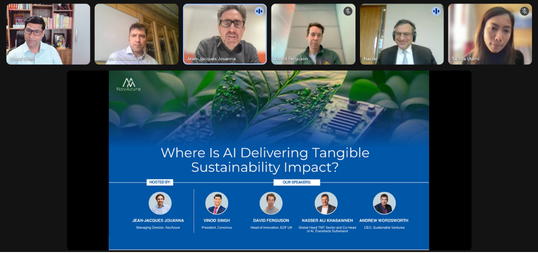
A full recording of the session is available for those interested: Here
Deepening the Conversation
Building on these conversations, NovAzure’s latest whitepaper, led by partner Woon-Hui Oh, provided the foundation of our webcast, connecting AI ambition with real-world sustainability outcomes and challenges.
We explored:
- AI as a driver of efficiency and system optimisation
- Real-world applications across energy, operations and circularity
- The AI–climate paradox and growing energy demands
- Deploying AI responsibly while unlocking business value
Iran Tensions and Energy Markets: Never Waste a Good Crisis
Christopher Gruen – Managing Director
Energy markets today are no longer driven by fundamentals alone—they are more and more often driven by geopolitics, sentiment, and uncertainty. Sitting in front of wholesale prices on behalf of a UK energy supplier being NovAzure’s client, the recent weeks has felt less like analysis and more like navigating noise, where the line between rumour and reality is increasingly blurred.
The escalating tensions around Iran are a stark reminder: countries reliant on imported oil and gas remain exposed, while those investing in electrification, renewables and diversification are building resilience. This is no longer just about sustainability—it’s about strategy.
We’ve seen this before. In the first energy crisis following Putin’s invasion of Ukraine, power prices surged and caught many suppliers off guard. Over 30 UK energy companies collapsed due limited hedged positions. Prices may not have returned to those extremes—but the lesson remains: exposure to a single fuel / supply source without structure is a big risk. Unfortunately, only a small number of suppliers as well as customers and in particular governments focus on the short term, rather than moving away from fossil fuels and fuel dependency altogether.
Yet many responses today are still short-term. Price caps and subsidies may ease immediate pressure, but they don’t solve the underlying problem—dependency.
The more fundamental shift is now becoming clear. Businesses and countries alike are starting to move beyond pure price optimisation towards energy resilience—through local generation, storage, and Power Purchase Agreements (PPAs) that provide stability and control.
Crucially, this is where the narrative around renewables needs to evolve.
Renewables are no longer just about addressing climate change.
They are about reducing exposure—to volatile global markets, geopolitical shocks, and concentrated supply routes.
Local, electrified and diversified energy systems are inherently more resilient. They give organisations and countries greater control over their energy position, rather than leaving them at the mercy of external events.
Never waste a good crisis. The current geopolitical environment is accelerating a transition that was already underway—from energy as a commodity to energy as a strategic asset.
Key takeaway: In an increasingly unstable world, energy is no longer just a cost to manage—it’s a risk to structure.
And increasingly, security is trumping profitability.
Read the full article: Here
Events we’re attending
Discover where our partners will be engaging with innovators, investors, and industry leaders.
ChangeNOW Paris
Paris, 30 (Mar) -01 (Apr)
An event responding to the biggest challenges of our century

Honda Xcelerator Ventures
Manchester, 02 (Apr)
Connecting Nothern climate space Honda Xcelerator Ventures

HTGF VC Lunch
Hamburg
Bringing together investors from VCs, CVCs, and active business angels

Continuing the Conversation