
What happened at COP31?
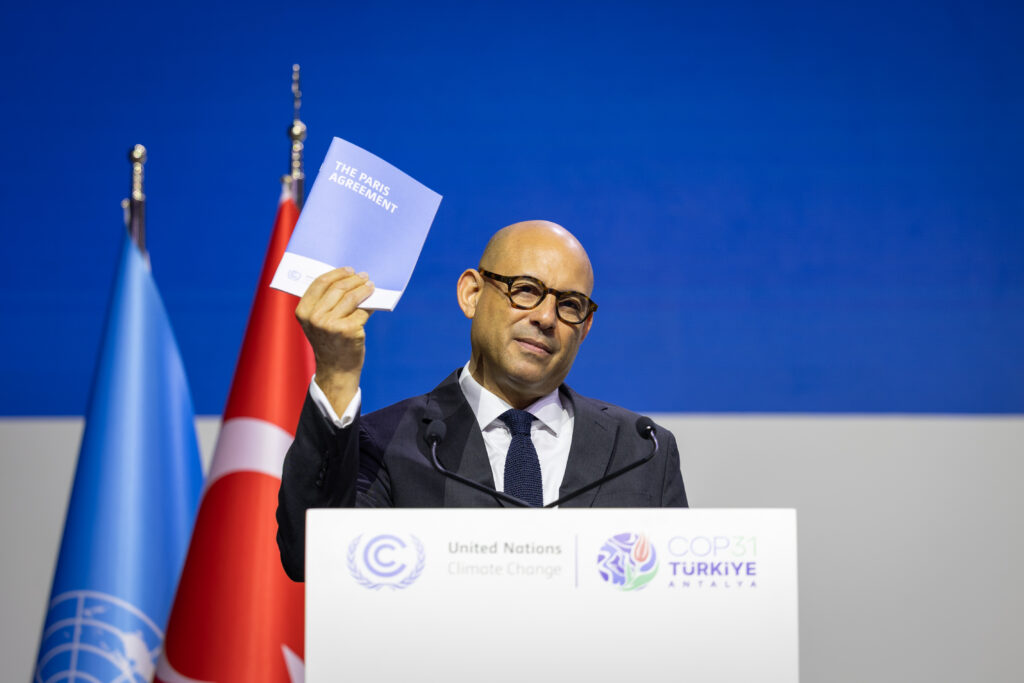
COP31 has ended with no clear outcome, with governments divided on fossil fuels, climate finance and a push to electrify the global economy. A revised draft late on Sunday dropped calls to phase out fossil fuels, and nations ultimately failed to strike a new climate deal after deliberations ran past Friday’s deadline.
However, the market is already moving. Businesses are seeing the effects of climate change on their doorstep and in their future supply chains, and more are now seeing the energy transition as a source of growth and profit rather than a cost.
There is now less time than expected. Climate impacts are arriving sooner and hitting harder than the models predicted, with 2026 delivering record heatwaves and flooding. A recent UN report showed the world will inevitably overshoot the 1.5°C goal set under the Paris Agreement.
What happened
COP31 felt different. Mainstream news coverage was noticeably thinner than at previous summits. After 31 years of COPs, this may reflect waning public interest, which tracks with the absence of several heads of state from the summit. Chinese President Xi Jinping, Indian Prime Minister Narendra Modi, French President Emmanuel Macron and German Chancellor Friedrich Merz all skipped the leaders’ segment.
Poor organisation was one of the main sources of failure in COP31. The sprawling agenda made the process untenable. The environment minister of Ghana, which currently leads the African Group of Negotiators, told delegates that stalled progress can cost lives, stressing the ever-increasing urgency of taking strong action.
The influence of fossil fuel majors was also hard to miss. Panama’s environment minister condemned what he called the global “oil mafia”. Australia drew heavy backlash for co-chairing negotiations, led by its energy and climate minister Chris Bowen, despite being one of the world’s largest fossil fuel exporters.
Where the talks ended
Fossil fuels: A revised late draft dropped calls to phase out fossil fuels and omitted the tough language from earlier versions.
Climate finance: Delegates scrapped over financial support for developing countries into the final hours, and a flagship number for adaptation funding was left out of the whittled-down document. Nations including the UK and Spain examined plans to use “small levies” to boost climate finance.
Electrification: Delegates recognised electrification’s benefits for emissions reduction and energy security, paving the way for an increased focus on shifting transport and heavy industry away from polluting fuels.
US engagement: A Democratic delegation of 18 House members, including Representative Yassamin Ansari of Arizona, travelled to Turkey to reassure allies that the US can play a positive future role, boosted by midterm wins that will put the party in control of the House and Senate next year. However, the US position creates a practical problem for everyone else. Capital is pulled back at a federal level now, but could return in two years, which makes it hard to model new financing commitments.
The 35-by-35 pledge
The closest thing to a headline outcome was the 35-by-35 pledge (35% of global energy will be electricity by 2035), which around 90 countries and 180+ businesses voluntarily endorsed, though it was not adopted as a formal COP decision.
ABB and Schneider Electric have both endorsed the 35-by-35 campaign. Both supply critical infrastructure for the energy transition, from grid equipment to energy management in buildings and data centres. At COP31, both have focused less on ambition and more on what it will take to deliver.
Schneider Electric was among more than 180 companies that signed a statement on 3rd November calling for electrification to be fast-tracked. ABB has joined a similar call from more than 100 companies to make clean electrification a central part of industrial strategy.
Electrification moves only as fast as the grid allows. IRENA warns that electricity networks are structurally unprepared for change on this scale. Meeting the 35% target would need annual investment in grids, storage and related infrastructure to double, from about $500 billion in 2025 to $1 trillion a year through 2035.
Data centres feel this first. An ITU official warned at COP31 that electricity demand from AI data centres is projected to double by 2030. From our own work, grid capacity and connection queues are already the main blocker to new data centre capacity.
The pledge measures how much electricity is used, not how it is generated. Some technology firms have reported emissions rising by around 50% in recent years as AI demand has grown. Electrifying a site on a fossil-heavy grid can increase emissions rather than cut them.
There is a counter-trend. Geopolitical instability and energy supply shocks have made energy security, not climate policy, the main reason that many countries are building renewables. The IEA’s Renewables 2026 report expects almost 4,800 GW of new renewable capacity between 2026 and 2031, nearly 60% more than in the previous six years (IEA). It also expects off-grid solar to grow 2.5 times, to around 80 GW by 2031, pointing to a more distributed energy system (IEA).
Further, the cost of adaptation to climate change is significant and a real burden on developing countries. Take Nepal as an example:
After floods in August 2026, Nepal became the first country to receive money from the UN Fund for Responding to Loss and Damage, which earmarked $21.6 million. Nepal’s losses are estimated at around $2.5 billion (US News), so the payout covers less than 1%.
COP31 Outcome
COP31 closed without a final agreement. However, our view is that the commercial case for the clean energy transition is unchanged.
Worsening climate impacts are widening the gap between the continued use of fossil fuels and the cost of dealing with their consequences. And that cost lands hardest on the countries who are least able to fund adaptation. Policy progress will stay uneven, so the transition will be driven by economics more than by negotiated text.
There are three key themes that we expect will shape the energy transition:
- Energy security will dominate in the near term priority. Geopolitical distraction will keep the major economies focused on security of supply, therefore pushing renewable energy that can be generated anywhere.
- Energy majors continue to be beholden to shareholders that demand returns in the high teens that they can only achieve today with a focus on fossil fuels. The energy industry transition impetus will come from elsewhere, for the time being – such as second-tier multinational and national energy companies.
- The business case for electrification will nevertheless strengthen over time, which should realign global energy supply patterns away from fossil fuel dominance.
The direction of the energy transition is clear however the speed at which the world is going is unclear. Clean energy is the right long-term economic driver, and the work needs to continue on that basis.
Sources
- COP31 Presidency, 35-by-35 Global Electrification Pledge (Sep 2026): cop31.tr
- UN News, COP31 enters decisive week (16 Nov 2026): news.un.org
- Global ABC, Antalya Compact for Energy Efficient Buildings (Oct 2026): globalabc.org
- Geoscience Australia, Australia’s energy production and trade (2026): ga.gov.au
- Climate Analytics, Australia: past its fossil fuel export date (Nov 2026): climateanalytics.org
- Bloomberg Green, Newsletter series, incl. “Four reasons COP31 failed” (16–22 Nov 2026): bloomberg.com
- Japan Times / Bloomberg, Push to electrify global economy stalls (16 Nov 2026): japantimes.co.jp
- AP via US News, At COP31, Nepal pushes for billions to help disaster survivors (16 Nov 2026): usnews.com
- CBC News, Nepal and the loss and damage fund (Nov 2026): cbc.ca
- Down to Earth, COP31 negotiations leader Australia set to maintain coal exports at 350 million tonnes a year until 2030 (Nov 2026): downtoearth.org.in
- TBS News, COP31 draft calls for fossil fuel phaseout, at least $120bn in adaptation finance (17 Nov 2026): tbsnews.net
- ESG Dive, Over 180 companies call on COP31 presidency to fix electrification bottleneck (Nov 2026): esgdive.com
- Taipei Times (AFP), Major leaders missing as COP31 runs in Turkey (12 Nov 2026): taipeitimes.com