

Sonnen did not fail because home batteries are a bad idea. It failed because its costs, its revenue model and its ownership set-up were built for a market that no longer exists. Every German energy start-up should check itself against those five points.
On 22 October 2026, Sonnen GmbH filed for insolvency. The company from Wildpoldsried in the Allgäu helped create the German home-storage market. It has more than 150,000 customers and was one of the first companies to network home batteries into a virtual power plant.
It is tempting to read this as one company’s misfortune, or as a story about one owner. I think that misses the point. The figures that are now public tell a more useful story about markets, business models and governance. They apply well beyond residential storage.
I’m based in Hamburg and spend more and more of my time with German start-ups and scale-ups in storage, flexibility and energy services. Here is what I take from Sonnen, and what I will be asking founders and investors as a result.
The views in this article are my own. They combine public reporting on Sonnen, linked throughout, with what I have seen first-hand working with energy start-ups, scale-ups, corporates and investors.
What happened
Sonnen filed for insolvency two months after a change of ownership. Its parent and several subsidiaries are being wound down or restructured under self-administration (Eigenverwaltung). Only one production site is expected to remain (pv magazine, citing Handelsblatt).
| Date | Event |
|---|---|
| 22 Oct 2026 | Sonnen GmbH files for insolvency; around 400 employees informed; customer service to continue |
| Aug 2026 | Sold to Tiven, the family office of Aurelius co-founder Gert Purkert, at a reported price in the low hundreds of millions of euros |
| 2024 | Owner provides additional cash to keep operations running |
| Sep 2023 | Owner announces it is seeking a buyer or majority investor |
| 2019 | Shell acquires Sonnen outright for a reported price of just under €500m |
| 2010 | Sonnen founded in Wildpoldsried |
The US business continues under new ownership and is reported to be growing. US sales roughly doubled and production tripled year on year (TaiyangNews). That contrast is part of the lesson.
Why Sonnen lost money
Sonnen’s losses were structural, not just the result of a bad year. According to its 2024 annual accounts, as reported by taz, the company had only one profitable year in its history: 2020, and only just. It still made a loss in 2023, when revenue grew by around 40%.
Then the market turned. The reported group figures (ZFK, citing Handelsblatt) show how hard:
| Group figure | 2023 | 2024 | 2025 |
|---|---|---|---|
| Revenue | €443m | €198.9m | not reported |
| EBITDA / loss | loss | −€188.7m (EBITDA) | −€52.2m |
| Headcount | up to ~1,700 at peak | 1,318 falling to 800 | ~400 at headquarters |
In 2024, the operating loss was almost as large as revenue. Cost cuts reduced the loss in 2025, but not enough, and not fast enough.
Four forces came together:
- Demand fell after the energy-crisis boom. Germany’s electricity-storage market fell by about 26% in value in 2024 (BVES via pv magazine). Home PV sales fell by about 28% in 2025 (BSW Solar via Clean Energy Wire), and around 8 in 10 new home PV systems now include a battery.
- Prices fell and Chinese suppliers scaled. Residential PV system prices fell by up to 25% in the twelve months to October 2024 (pv magazine). A premium product lost the ability to charge a premium.
- The cost base was built for growth. More than 11 markets, own manufacturing and a peak workforce of around 1,700 people. When revenue halved, fixed costs did not.
- The software and community business did not make up for it in Germany. Sonnen networked its batteries long before most competitors. But in Germany, where the metering, data and market rules for household flexibility were not in place (see Lesson 3), it did not earn enough to offset the decline in hardware margins.
The headcount figures are not consistent across reports and cover different entities and dates. The direction, however, is clear.
Lesson 1 — Market: build the cost base for the trough, not the boom
The energy crisis of 2022–23 created exceptional demand for home PV and storage. Much of the sector, Sonnen included, sized its organisation for that demand. In 2025, the number of new home-storage systems above 1 kW in Germany fell by around 20% to roughly 366,000, and capacity added fell by 6.4% (Battery Charts / RWTH Aachen via pv magazine).
A crisis-driven peak is not a baseline. The question I now ask every founder is simple: at today’s prices and at last year’s lowest monthly volume, where is your break-even? If the answer depends on a return to boom conditions, the plan is a bet on the market, not a business.
The same applies to geography. Sonnen operated in more than 11 markets before it had a profitable home market. Every new country adds fixed costs — entities, teams, certifications, service networks — long before it adds margin. Expansion should follow profitability in the core market, not replace it.
Lesson 2 — Model: hardware stopped being a moat, and software alone did not replace it
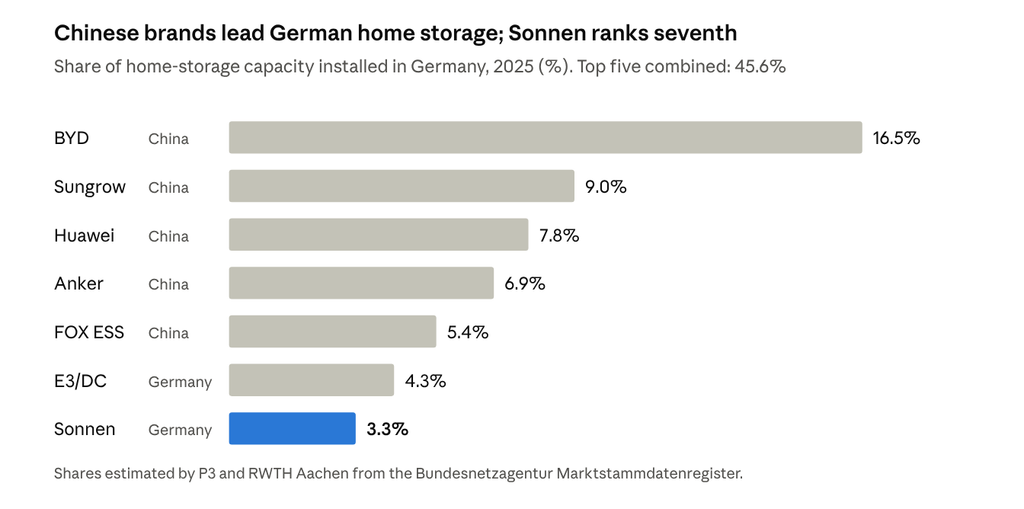
In 2025, the five largest suppliers of home storage in Germany were all Chinese-headquartered. Sonnen, once the market leader, held 3.3% of installed capacity (pv magazine).
pv magazine Deutschland, 26 June 2026 · P3 / RWTH Aachen analysis of the Marktstammdatenregister · 2025 installations
Two things stand out. First, the market is fragmenting rather than consolidating: the top five’s share fell from nearly 55% in 2024 to just over 45% in 2025. Second, new entrants such as Anker and FOX ESS overtook both German premium brands within a single year, partly through balcony storage and installer-friendly channels.
A premium brand cannot defend a large price gap in a product that buyers increasingly see as a commodity. But Sonnen was never just a hardware company. It had a community model, an energy tariff and a virtual power plant years before its competitors — and it still lost. The lesson is not “add software”. It is: build a revenue line that someone is contractually paying for, and make sure it grows faster than hardware margins shrink.
The test I apply: what share of gross margin comes from recurring, contracted revenue, and is that share rising?
Lesson 3 — Monetise: flexibility only pays where someone pays for it
The most interesting part of the Sonnen story is the contrast between Germany and the US. The same technology and the same virtual-power-plant idea produced very different results, because the markets reward flexibility differently.
In the US, the model has a buyer. In Texas, Sonnen supplies batteries to Solrite, which owns them, installs them at no upfront cost to homeowners and earns its return by dispatching them into the ERCOT wholesale market through retail electricity providers. Homeowners sign 25-year agreements. In its first five months the programme deployed around 40 MWh across more than 1,000 homes (Canary Media). Someone pays for the flexibility, and the contract makes the revenue predictable.
In German homes, the infrastructure to get paid is still missing. By mid-2025, smart meters had been installed at only 16.4% of the sites where they are mandatory, and at around 3% of all metering points (pv magazine, citing Bundesnetzagentur data). In Great Britain, 72% of meters were smart or advanced by June 2026 (DESNZ).
Regulation has not helped. The 2025 Market Monitor for Demand Side Flexibility by LCP Delta and smartEn puts dynamic-tariff uptake in Germany at just 1%. It also notes that Germany missed its 2025 smart-meter target, and that independent aggregators still need a compensation agreement with the customer’s supplier to access wholesale markets (LCP Delta / smartEn). The market is also highly fragmented: the average household can choose from 139 electricity suppliers (Bundesnetzagentur), and aggregators must coordinate with around 800 distribution network operators. In Great Britain, by contrast, aggregators can trade on behalf of customers, and distribution networks have contracted 9 GW of flexibility since 2024 (same LCP Delta source).
The result is that the route to market for a household VPP in Germany is unclear, and the metering and data it depends on are largely absent. This is starting to change: a simpler “Smart Meter Light” was adopted in the government’s July 2026 reform package (Euronews). For Sonnen, it came too late.
Commercial and industrial buildings are a different starting point. C&I sites already have metered load profiles, a professional energy buyer and clear costs to reduce:
- Peak charges. Grid fees for larger customers are typically billed on the highest demand peak of the year. Every kilowatt shaved off that peak is money saved, independent of any wholesale market (Solarserver).
- Avoided levies and fees. Every kWh used on site instead of drawn from the grid avoids roughly 5–15 ct of levies and network charges on top of the energy price (same source).
- Negative prices. For PV installed since February 2025, feed-in is not paid during negative-price quarter-hours. Storing that energy has zero opportunity cost.
The market is responding. Commercial storage capacity added in Germany grew by 47% in 2025, to 0.36 GWh across nearly 5,900 systems, while home storage shrank (Battery Charts / RWTH via pv magazine).
The sequence matters. A company already present in C&I buildings can earn first from savings on site, which the customer sees directly on the bill. It can then aggregate the flexible capacity that is left over and sell it into markets. That is a much stronger footing than starting with a VPP and hoping the savings follow.
Lesson 4 — Governance: deep pockets slow the reflexes
A start-up on its own reacts to a falling market within weeks, because it has to. A start-up with a large shareholder behind it often reacts more slowly, because it can. That is not a criticism of any shareholder. It is a pattern I have seen many times, and Sonnen is a clear example.
According to press reports, Sonnen received further capital after its 2019 acquisition — reportedly more than €500m through 2025, including a cash injection in 2024 to keep operations running (ZFK; pv magazine). That support kept the company alive. It also meant that the full force of the 2024 downturn never had to be absorbed by the business itself. The deep cuts came later, when they were harder and more expensive.
My advice to founders and boards with a strategic investor behind them:
- Measure runway as if the shareholder were not there. Report cash and runway monthly on a standalone basis. If the business only survives with further support, everyone at the table should be able to see that.
- Agree the triggers in advance. For example: if revenue falls more than 20% against plan for two consecutive quarters, management presents a cost plan within 30 days. Decisions made in calm conditions are better than decisions made in a crisis.
- Put independent voices on the board. A board made up only of founders and the strategic investor’s representatives has blind spots on both sides.
- Treat support as a bridge, not a business model. Each injection of capital should come with a clear milestone it is meant to reach.
Lesson 5 — Plan the ownership transition before it plans you
Corporates invest for strategic reasons, and strategies change. That is normal. What matters is whether the start-up is ready when it happens.
In Sonnen’s case, the search for a buyer was announced in September 2023 and the sale closed in August 2026, nearly three years later (pv magazine). The reported price was a fraction of the 2019 purchase price, and the buyer was a restructuring investor. Three years of uncertainty is a long time for customers, installers and employees, and it rarely improves the price.
Two things founders can do:
- Agree the exit route while the relationship is good. Pre-emption rights, a right of first offer, a defined process and timeline, and a shortlist of investors who could take over the stake. Founders who prepare this early negotiate from strength. Those who wait become forced sellers.
- Secure the funding path before the cap table changes. A loss-making scale-up depends on someone being willing to fund the gap to profitability. A new owner has no obligation to continue what the previous one did. Committed funding should be agreed in writing before a change of control, not after.
We do not yet know why the new owner filed for insolvency so soon after the purchase. In Germany, self-administered insolvency can be a deliberate restructuring tool. But the timing shows how little room a loss-making company has once its ownership changes.
What this means for German start-ups and scale-ups
Sonnen’s insolvency is not the end of storage in Germany. Battery capacity added in Germany still grew by 8% in 2025, with large-scale storage up 81% and commercial storage up 47% (pv magazine). Value is moving — from selling boxes to homeowners towards managing flexibility where it is measured and paid for.
The companies that will win are the ones that pass five tests:
| Test | The question I ask |
|---|---|
| Market | Where is break-even at today’s prices and the lowest recent volumes? |
| Model | What share of gross margin is recurring and contracted — and is it rising? |
| Monetise | Who pays for the flexibility, under what contract, and how is it measured? |
| Governance | How many months of runway does the business have without shareholder support? |
| Ownership | Is there an agreed plan for the next ownership chapter? |
Looking ahead: the same lessons in Southeast Asia
Southeast Asia today resembles Germany a few years ago. Storage demand is growing fast, but it is still driven mainly by government tenders rather than by markets that pay for flexibility (Argus). That makes the Sonnen lessons more relevant there, not less — above all the first: do not build the cost base ahead of the market rules.
Some markets are moving faster than others. Singapore has the most advanced rules: virtual power plants can already trade in the wholesale market, and a new target of around 1 GWh of storage by 2030 is out for industry consultation (ESS News). In the Philippines, batteries already earn money from the reserve market (energy-pedia). Malaysia and Vietnam are scaling through utility tenders and new rules for commercial solar, but markets that pay for flexibility at customer sites are still to come (Energy-Storage.News; Việt Nam News).
The sequence is the same as in Germany: start where a commercial or industrial customer saves money on site today, and add market revenue where the rules already pay for it — today most clearly in Singapore and the Philippines.
Let’s talk
From Hamburg, I am spending more and more of my time with German start-ups and scale-ups in storage, flexibility and energy services. Germany has the engineering, the customers and an energy market that urgently needs flexibility. What it needs now are business models that turn that flexibility into cash.
If you are building in this space, in Germany or in Southeast Asia, or thinking about the next capital or ownership chapter of your company, I would be glad to compare notes.
Sources
- pv magazine Global — Sonnen files for insolvency (22 Oct 2026)
- ZFK — Sonnen stellt Insolvenzantrag (22 Oct 2026)
- taz — Solarpionier insolvent (23 Oct 2026)
- Energy-Storage.News — Sonnen files for insolvency in Germany (Oct 2026)
- TaiyangNews — Germany’s sonnen GmbH faces insolvency as US business expands (23 Oct 2026)
- pv magazine Deutschland — Shell verkauft Sonnen an Tiven (28 Aug 2026)
- pv magazine Deutschland — Strukturwandel im Heimspeichermarkt 2025 (26 Jun 2026)
- pv magazine Deutschland — 6.57 GWh battery storage added in Germany in 2025 (8 Jan 2026)
- pv magazine — German home battery sales collapse (BVES data, 26 Mar 2025)
- pv magazine — Residential PV prices in Germany drop 25% (24 Oct 2024)
- Clean Energy Wire — Demand for home PV slows in Germany (BSW Solar data)
- pv magazine Deutschland — Smart-Meter-Rollout (22 Oct 2025)
- Solarserver — Gewerbespeicher: Acht häufige Fehler (1 Apr 2026)
- Canary Media — Sonnen, Solrite to offer free batteries and solar to Texas homeowners (16 Jan 2025)
- LCP Delta and smartEn — 2025 Market Monitor for Demand Side Flexibility
- DESNZ — Smart meters in Great Britain, quarterly update June 2026 (27 Aug 2026)
- Bundesnetzagentur — Monitoringbericht 2025 (26 Nov 2025)
- Euronews — Why has Germany been so slow to adopt smart meters? (1 Aug 2026)
- Argus — Viewpoint: Asia energy storage to accelerate in 2026 (7 Jan 2026)
- ESS News — Singapore targets 1 GWh of energy storage by 2030 (27 Oct 2026)
- energy-pedia — Scatec JV starts commercial operation of battery system in the Philippines (17 May 2026)
- Energy-Storage.News — Malaysia launches tender for 2.5 GW of solar PV with co-located storage (2026)
- Việt Nam News — Việt Nam raises rooftop solar sales cap to 50% (16 Jul 2026)