
NovAzure Battery Storage Value Calculator™
Numbers move BESS deals. Stories don’t.
Whether you are selling battery storage systems or allocating capex to a new energy asset, translating technical performance into a clear, reliable business case is key.
When a business case is built, it usually sits in complex spreadsheets that are slow to adapt, difficult to audit, and struggle to credibly model degradation and front-of-the-meter or behind-the-meter revenue stacking. That leaves finance teams unsure whether to trust the output, particularly with such a fast-moving technology.
Investment committees and board decision-makers will not put their capital on the line for opaque vendor assumptions. They need transparent, decision-grade economics, not spreadsheet guesswork.
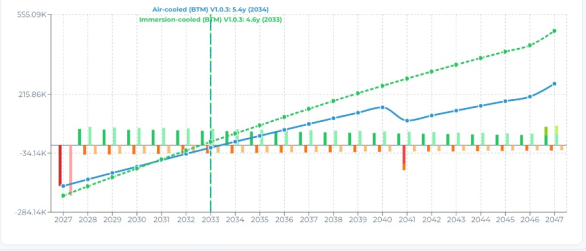
Illustrative output. Payback and IRR for two technologies on the same customer inputs.
The NovAzure Battery Storage Value Calculator™ Provides Clear, Decision-Grade Business Cases
Giving you:
Significant time saved compared with Excel models.
Verifiable maths that helps you win/close more deals.
Current market data and models, kept up to date for you.
Full confidentiality and protection of company data
Built specifically for stationary battery storage, it models defensible, customer-specific business cases for front-of-the-meter and behind-the-meter projects in seconds.
Powered by NovAzure’s maintained data lake and regularly refreshed market data, including regional electricity tariffs, grid carbon intensity and battery degradation benchmarks. It keeps your project economics credible as energy markets move.
No in-house financial modelling, fragile spreadsheets, or added delays. The platform is fully managed by NovAzure, it needs no ongoing maintenance from your team, and deploys ready for customer conversations in 3 to 6 weeks.
Built for shared, multi-user deployment across global sales teams, integrators, EPCs and investment committees. It gives you a single, auditable source of facts that aligns commercial proposals with board-level scrutiny.
Whole-life TCO, NPV, IRR, gross margin and payback are all quantified and explained in plain English, so the commercial case for a battery technology and its price makes itself.
Case Study: Global Energy Major
A global energy major needed to demonstrate the commercial superiority of their advanced liquid cooling fluids for battery storage, but their internal spreadsheet models were too complex to use in live sales conversations.
The Value Calculator is used to:
- Empower Global Sales: sales teams model TCO, cycle life and degradation live with customers.
- Prove Economic Uplift: calibrated with empirical OEM data, the model shows how their immersion cooling technology improves BESS project economics.
- Accelerate Deal Conversion: transparent, plain-English calculations cleared rigorous technical and commercial benchmarks, giving C-suite buyers the confidence to commit and establishing our client as a market leader in BESS cooling.
“We partner with NovAzure because they bring deep knowledge and expertise in the sector, together with the capacity to accelerate our progress. We believe the Value Calculator will help us significantly in our Business Development. Execution quality matters, and NovAzure consistently deliver in that respect.”
Director, Global Energy Major
THE METRICS
The modelling that helps secure deals
TCO, NPV, IRR, Gross Margin & Payback
The metrics a buyer’s finance team actually asks for.
Revenue Modelled Both Ways
Front-of-the-meter (wholesale arbitrage, capacity, ancillary services) and behind-the-meter (peak shaving, demand charge reduction, demand response).
Cooling Technologies Compared Head-to-Head
Air, glycol/indirect and immersion cooling, with degradation curves and mid-life augmentation built in.
Two-Tier: High-Level & Engineering Views
Plain-English inputs for rapid testing of live scenarios, backed by an advanced parameters view for technical diligence.
Questions We Get Asked
Can sellers, buyers and specifiers use it?
Yes. It is built for sellers, buyers and specifiers. EPCs and investors can also use it as a neutral baseline to compare technologies and challenge vendor cases.
How is battery degradation handled?
It models cell degradation over time (for example, LFP degradation curves, with typical cycle-life limits of roughly 8,000 to 10,000 cycles depending on cooling type), plus mid-life replacement or augmentation.
Where does the market data come from?
Public data, industry partners, and aggregated, anonymised insights from our engagements. Sources are traceable and refreshed regularly.
How long does set-up take?
Typically 3 to 6 weeks, depending on how established your value framework is.
Does it optimise dispatch or run live trading?
No. It models revenues on tariff spreads, market rules and duty cycles. It is a business-case tool, not a real-time or sub-hourly dispatch optimiser.
What Our Customers Say About NovAzure


Customer Stories
Showing 2 / 16


